

By Mohamed El Dahshan, Senior Fellow at Global Nation
It’s a question we should not have to ask: Is the international community approaching Syria with the intent to support and enable a successful transition, or with the expectation – not to say a wager – on its failure?
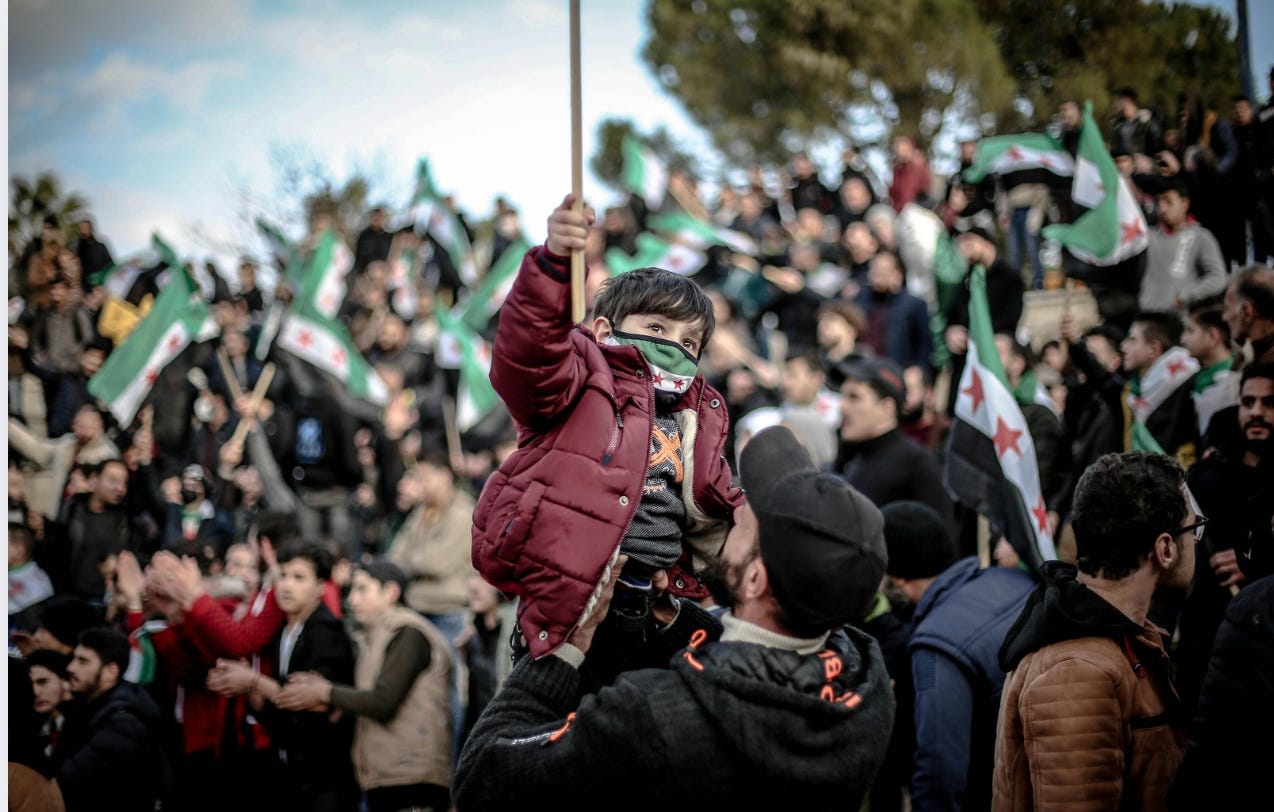
After nearly 14 years of war, more than half a million dead, five million refugees and seven million internally displaced, the answer should be clear. The flurry of diplomatic attention towards Damascus since the fall of Bashar Al-Assad on December 8th should have been a promising sign. A stable Syria is squarely in the global interest, yet early indications have been disappointing.
The global experience of transitions: We should know better
Global experience with civil wars - as well as my own as an expert in conflict and post-conflict economies (most recently as senior advisor to the UN mediation mission to Yemen), reminds us of the importance of post conflict support. Not just for socioeconomic development, but for political stability. Reconstruction processes are inevitably complex and require a multi-staged [approach], simultaneously working on a variety of social, security, economic, and political priorities. Post-conflict support is deemed essential for reducing poverty in former war zones, a significant way of resolving and preventing conflict.
Likewise, military actors such as The North Atlantic Treaty Organisation (NATO) also recognise stabilization and reconstruction as two sibling functions…stabilization efforts reach their peak in the early phases of the intervention, whilst reconstruction is already in place.
In fact, the preparatory work conducted and readiness displayed by Ukraine's international partners to assist with its eventual reconstruction process is an excellent, and laudable model. Highlighting the long-term nature of the commitment required, the imperative of local leadership and ownership, the inclusion of the local population and civil society, and planning conducted by Ukraine as well as international donors should be the global standard to emulate.
Preliminary scorecard
This however has been almost entirely absent from the global discourse on Syria.
Hours after the fall of Al-Assad, European countries’ initial reaction was a race to announce the suspension of applications for Syrian asylum seekers. Austria went one further and announced it was preparing a repatriation and deportation programme. Ten days later, the European Council somewhat tempered those statements, calling for the "safe, voluntary and dignified returns of Syrian refugees."
A week later, Jordan hosted a roundtable in Aqaba, bringing together Turkey, Iraq, Saudi Arabia, Lebanon, Egypt, the US, and the EU. It focused primarily on the prospects of the Syrian political transition, eschewing the economic and social needs of Syrians. The Arab group within the Aqaba meeting issued a separate statement, also making no reference to Syria's reconstruction and development.
European foreign ministers visiting Syria in the beginning of January stated that they "want new relationship with Syria" but have fallen short of offering tangible assistance.
Most sanctions imposed on the Assad regime remain in place
Sanctions imposed on Syria have significantly impacted and continue to impact the daily life of Syrians, in far-reaching and brutal ways likely not envisaged by imposing authorities. The term ‘smart sanctions’ is in essence, an oxymoron. Syrian economist Karam Shaar summarises the key impacts of sanctions: “restricted access to international markets, stifled private sector growth, and hindered economic recovery by elevating transaction costs and reducing investment opportunities. These measures have also strained humanitarian efforts, as compliance challenges inhibit the delivery of assistance.”
Interim foreign minister Asaad Al-Shibani rightly described the sanctions as "a barrier and an obstacle to rapid recovery". Numerous voices, both within and outside Syria, have called for their removal. In an economically difficult period for donor countries, removing sanctions would cost them nothing. Yet, they remain in place.
On December 20th, the US dropped a bounty for the arrest of Ahmed Al-Sharaa. Then, on January 5th it issued a six-months exemption – also known as a General License - allowing for transactions with the Syrian government, while upholding sanctions. EU High Representative for Foreign Affairs Kaja Kallas declared that the Syrian leadership "had made positive signals", while deeming them insufficient, and that they "are judged by the deeds, not only the words. So the coming weeks and months will show whether their deeds are going to the right direction."
In a parliamentary briefing on the 18th of December 2024, French Foreign Affairs Minister Jean-Noël Barrot envisaged a role for his country in Syria, "namely financial assistance to reconstruction and lifting some EU sanctions against Syria (...) those against economic sectors or Syrian state institutions could, at the right moment, be reevaluated”, “provided that a political transition takes place which respects the plural character of Syria, human rights and women's rights, and which offers us the guarantees that we expect for our security interests”; and that HTS will be judged “not on its words but on its actions, and so over time”.
International discordance
While the aforementioned priorities are naturally laudable and must be integral to Syria’s institutional reconstruction, the cardinal dissonance here is the forceful interjection of sequencing, if not conditionality, ahead of reconstruction assistance. Political, social, and economic transitions must occur in parallel – and promptly.
Post-war transitions are volatile. Syrians do not have ‘weeks and months’; nor should they have to wait any longer for relief, and to feel the benefits of the end of the war. Moreover, political stabilisation will need to occur alongside social and economic stabilisation for the population. Economic growth can scarcely take place without a stable political framework, and any political project needs to be able to deliver for the population.
Humanitarian assistance, short-term by its very nature and perennially underfunded, simply cannot fill this gap. This prompted Jens Laerke, spokesperson of the United Nations Office for the Coordination of Humanitarian Affairs (UN-OCHA), to make the unusual call to “advocate for support to longer-term reconstruction which lies outside of the humanitarian mandate, but will be “vital” to reducing humanitarian needs in the future in a sustainable way.”
Rebuilding the Syrian economy, rebuilding Syria
Estimates for the cost of reconstruction over the years have ranged from 250 billion to 1 trillion dollars – yet the absence of an accurate estimate of the war’s impact across all sectors presents an initial challenge.
A survey of conflicts over the past two centuries concluded that a typical war sees GDP per capita drop by 9% relative to its pre-war level, and that the most damaging wars “erode income levels massively, by between 40% and 70%.” Syria’s GDP has contracted by 53.3% between 2010 and 2022, according to official data. However, using alternative proxies, such as nighttime light, the World Bank estimates the economy has contracted by a staggering 84% between 2010 and 2023. Key economic sectors, such as agriculture and oil, have been decimated; hyperinflation is rampant. The UN World Food Programme reminds us that more than 90% of the population is below the poverty line, living on less than $2.15 a day.
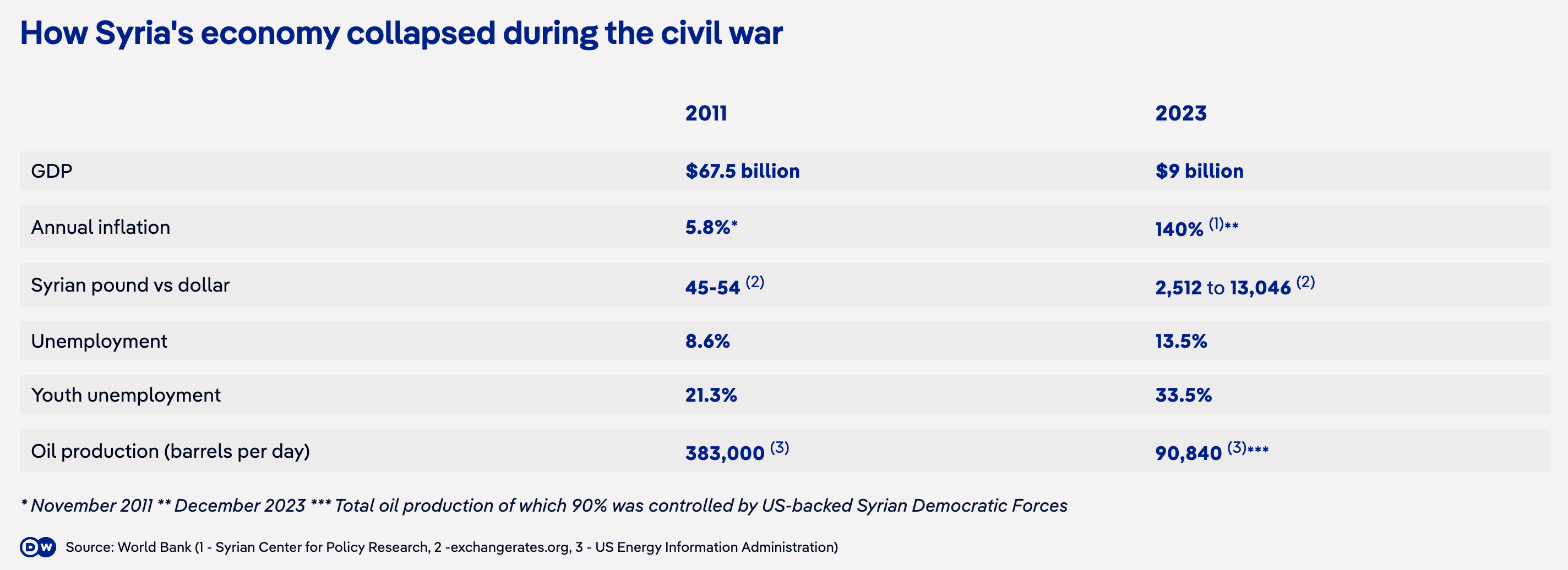
Source: DW. (2023)."What's next for Syria's devastated economy?" Data derived from the World Bank.
The past few years of apparent relative calm were not accompanied by reconstruction efforts, but by resource capture; Assad generously rewarding his allies local and foreign, and himself. Since Syria rejoined the Arab League in 2023, its neighbours were hopeful it would allay the flows of refugees and Captagon, a cheap drug that the Syrian regime had taken to manufacture and export regionally. Damascus chanced a hand it hoped might pay off, insisting that the return of refugees would be contingent on regional actors financing an eventual reconstruction. However, such a deal did not materialise.
The next steps
The world must stand with the Syrian people. This is no time for "crowing from the sidelines." It is more than a moral imperative vis-a-vis a nation that has endured one of the longest and, after the Congo, the second deadliest war of this century. Today, Syrians are eager to rebuild their country after 14 years of incredibly brutal war. They will need all our support.
It is also in the world’s interest. Syria’s strategic location in the eastern Mediterranean -bordering Turkey, Jordan, Lebanon and Israel- has made Syria a geopolitical ally, if not prize, to global powers for the past two centuries. The civil war quagmire is not a local conflict; Russia, the US, Iran, Turkey, Qatar, Saudi Arabia, France, and the UK have all been parties to this war in different measures. The world has also experienced the cost of its destabilisation, with terrorist organisations finding free rein in the lawlessness the country has experienced.
In the words of British MP and former Minister of State for Security Tom Tugendhat put it, "if we get Syria right in 10 years, Syria could be absolutely not just a pole of stability but a fantastic economic powerhouse in the region, exporting stability and civilisation, as it has done for quite literally tens of thousands of years, to the rest of the world again." Former CIA Official Marc Polymeropoulos argues, “we must encourage engagement, not isolation” because this is the only way to ensure that a new Syrian government is both inclusive for all Syrians and functional, offering services and security for the nation.”
The world must first decide whether it intends to give the country’s new rulers the benefit of the doubt. It very much should, despite all their flaws –and they are numerous– and engage with every intention to help maintain the nascent fragile stability.
In so doing, the international community must move away from setting unattainable preconditions to contribution to Syria's stabilisation and reconstruction. Political and economic assistance must be supportive -and very, very generous.
Sanctions should urgently be lifted, beginning with those targeting the Syrian Central Bank and key economic sectors, such as oil production, which would help alleviate energy shortages as well as provide the country with much-needed revenue.
Far more effectively, donors may choose to tie their contributions to political and social checkpoints on human rights including women’s rights; and political and social inclusion; if not met, donors can subsequently withhold aid, even impose new sanctions should Damascus fail to meet its obligations.
The complex web of sanctions –some UN-mandated, some unilateral– must urgently be detangled, and removed; the only cost of doing so is political will. As these measures are being implemented, urgent temporary measures should also be considered. The US General License announced in early January, though insufficient and time-limited, is nonetheless a remarkable first step which should be emulated by others, to allow the Syrian authorities and private sector to rejoin global trade and investment networks and rebuild international ties.
Ultimately, our cues should be taken from Syrians themselves. They have shown cautious optimism in the face of the current transition. Our collective duty – and interest - is to support their efforts in rebuilding their country.
Mohamed El Dahshan is a Senior Fellow at Global Nation and co-founder of OXCON Frontier Markets, a consulting firm focused on fragile states. He has served as Senior Economic Advisor to the UN Special Envoy for Yemen, West Africa Economist and Senior Cooperation Advisor at the ADB, and senior consultant to UNDP in Jerusalem. Mohamed is an Archbishop Tutu Leadership Fellow, a UN Alliance of Civilisations Fellow, and a member of the World Economic Forum's Global Agenda Expert Councils. He also serves on the advisory boards of the Tahrir Institute for Middle East Policy and the Mandela Rhodes Foundation.